
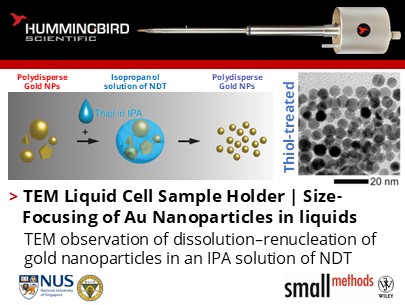
How can size-focusing of gold nanoparticles be directly observed with In Situ TEM?
Wenhui Wang, Utkur Mirsaidov and their colleagues from the National University of Singapore and Southeast University used Hummingbird Scientific’s liquid-cell TEM sample holder to visualize, in real time, the transformation of polydisperse Au nanoparticles into monodisperse sub-10 nm particles in the presence of thiol ligands. Their work provides direct mechanistic evidence that size-focusing occurs via complete dissolution of initial particles followed by renucleation and growth, rather than by etching or splitting.
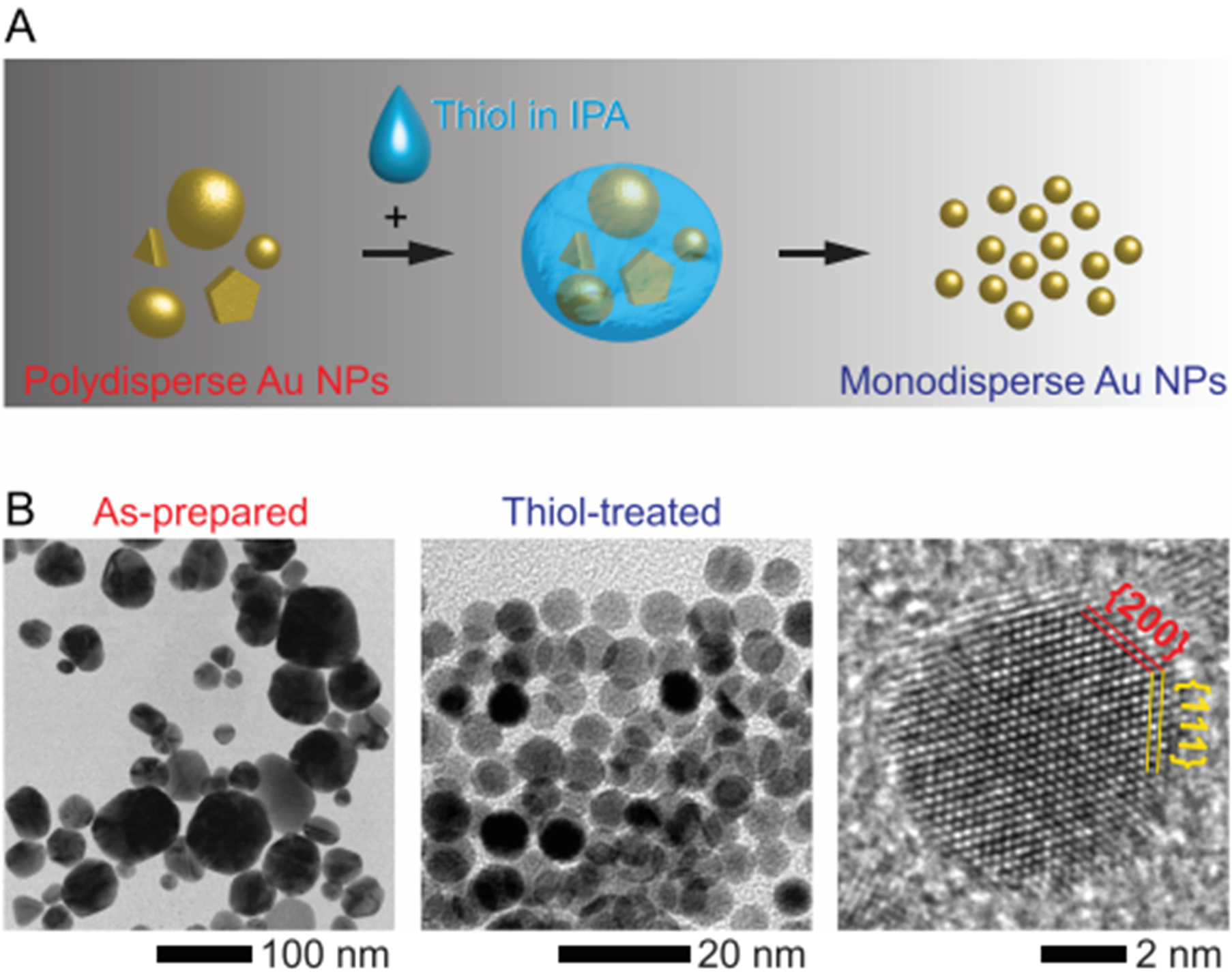
As-prepared and thiol-treated Au NPs. A) Schematic illustration of a transformation of polydisperse Au NPs into small monodisperse Au NPs in an IPA solution of NDT. B) TEM image (left) of as-prepared polydisperse Au NPs. Low- and high-magnification TEM images (middle and right, respectively) of NDT-treated Au NPs. Red and yellow lines mark the spacings of Au {200} and {111} crystal planes, respectively. © 2025 Wiley-VCH GmbH
The study demonstrates that size-focusing of gold nanoparticles is observed to occur via a two-step mechanism. First, the initial polydisperse nanoparticles dissolve under the influence of thiol ligands. This is followed by the nucleation and growth of new, smaller, monodisperse nanoparticles. These findings differ from earlier indirect studies that suggested etching or splitting as the primary mechanism. By revealing the actual dissolution–renucleation pathway, this work offers critical insights for synthesizing uniform nanoparticles for diverse applications.
Reference: Wenhui Wang, Mingyun Zhu, Ivan Erofeev, Guoming Lin, Kuibo Yin, Litao Sun, and Utkur Mirsaidov. Small Methods, 2025, e01033. DOI: 10.1002/smtd.202501033.
Full paper Copyright © 2025 Wiley-VCH GmbH. All rights are reserved
View All News