
How does liquid phase TEM enable direct visualization of biomolecule interactions at material interfaces?
Anyesha Chakraborty, Basudev Lahiri, and Chandrashekhar Tiwary from IIT Kharagpur; Felipe Hawthorne and Cristiano F. Woellner from Federal University of Paraná; and their collaborators at University of Allahabad and Indian Institute of Technology (BHU), worked closely with Prikshat Dadhwal and Saka Pranith Chander from Hummingbird Scientific on a recent publication using the Hummingbird Scientific in situ TEM liquid flow sample holder to uncover how norepinephrine molecules interact and bind with two-dimensional aluminum quasicrystals. This work focuses on understanding biomolecule–metal interfaces at the molecular level—an area critical for advancing sensing technologies, bioelectronics, and functional nanomaterials.
By combining spectroscopy, simulations, and real-time in situ liquid-phase TEM (LPTEM), the team directly correlated molecular binding mechanisms with dynamic interaction processes. Under controlled liquid flow, LPTEM enabled visualization of norepinephrine transport, initial adsorption at flake edges, and subsequent site-specific binding across the quasicrystal surface, capturing transient events as they evolved. These time-resolved observations provided direct insight into biomolecule–surface interactions in a native liquid environment, bridging the gap between ex-situ characterization and in-situ behavior.
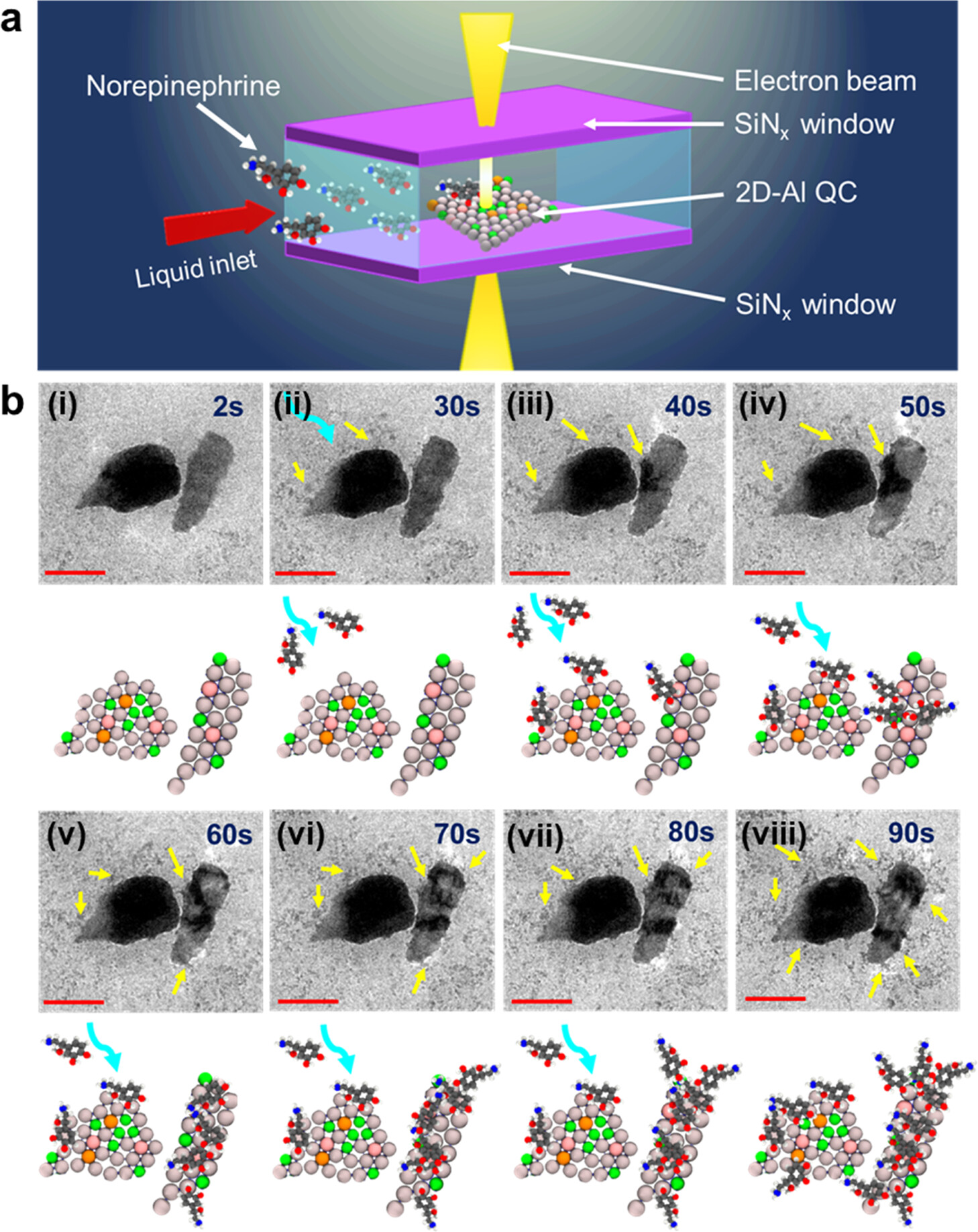
(a) Illustration of the in situ liquid cell TEM configuration. (b) Corresponding schematic diagrams and time-resolved LPTEM images showing the interaction dynamics between 2D aluminum quasicrystals and norepinephrine. The scale bar in each image is 100 nm; cyan arrows denote the direction of liquid flow, while yellow arrows highlight norepinephrine molecules attached to the 2D-Al QC surface. Copyright © 2025 American Chemical Society
Building on these insights, the researchers developed an ultrasensitive and highly selective electrochemical sensor for neurotransmitter detection. The Hummingbird Scientific in situ TEM liquid flow sample holder delivered stable imaging under continuous liquid flow, enabling time-resolved capture of transient binding events and unlocking new understanding critical for biosensor and bio–nanomaterial development.
Reference: Anyesha Chakraborty, Felipe Hawthorne, Thakur Prasad Yadav, Nilay Krishna Mukhopadhyay, Prikshat Dadhwal, Pranith Chander Saka, Basudev Lahiri, Cristiano F. Woellner, & Chandra Sekhar Tiwary, Deciphering the Interface between Two-Dimensional Aluminum Quasicrystals and Norepinephrine Neurotransmitter. ACS Appl. Mater. Interfaces 17, 68552−68565 (2025) DOI: 10.1021/acsami.5c10972
Full Paper Copyright © 2025 American Chemical Society
View All News