
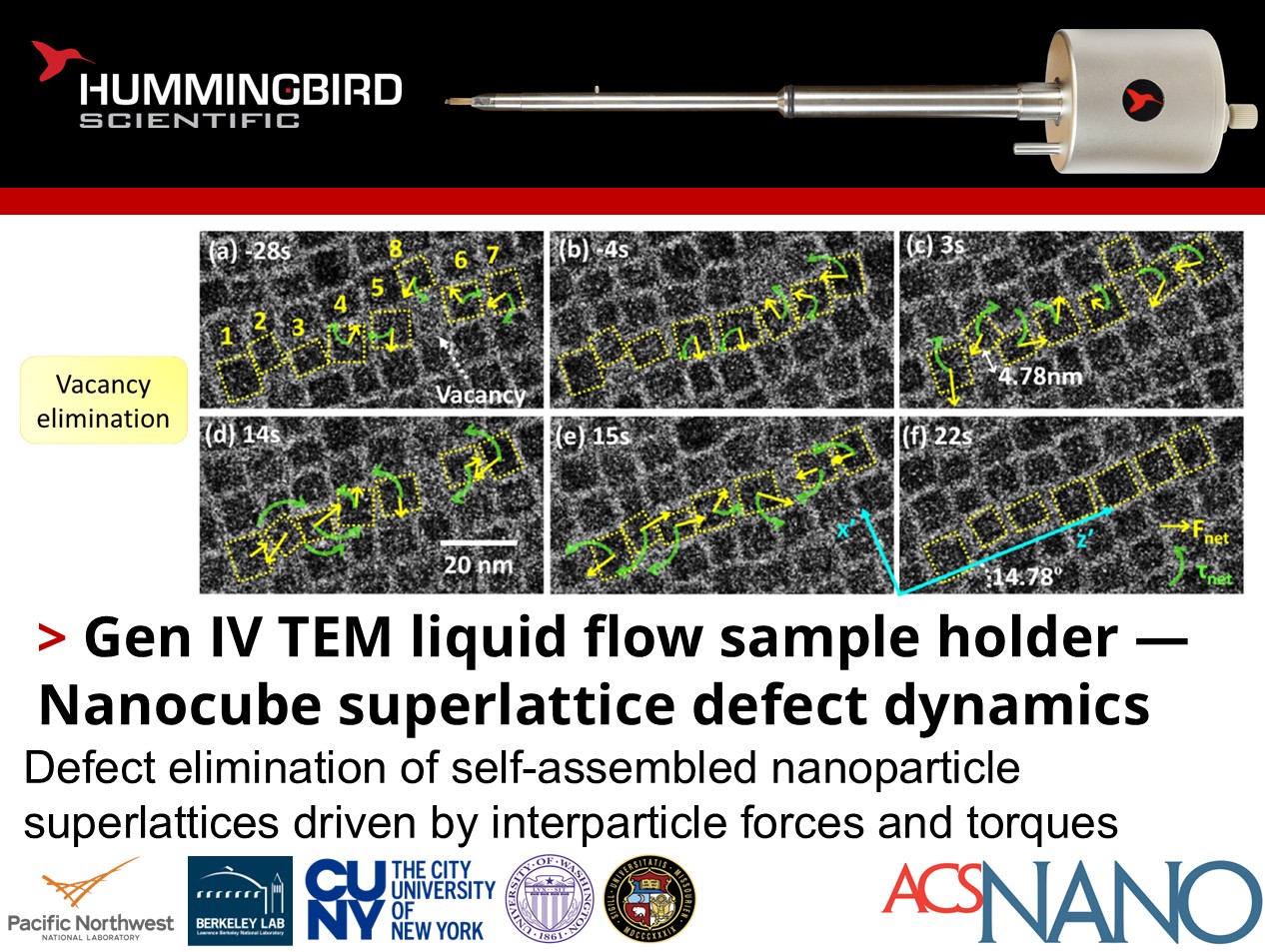
How do defects self-eliminate in self-assembled nanoparticle superlattices?
Jaewon Lee, Dongsheng Li, James De Yoreo and their colleagues at the Pacific Northwest National Laboratory, Berkeley Lab, the University of Washington – Seattle, and CUNY City College of New York have used the Hummingbird Scientific Gen IV liquid flow TEM holder to observe self-healing dynamics of palladium nanocube superlattice defects during self-assembly.
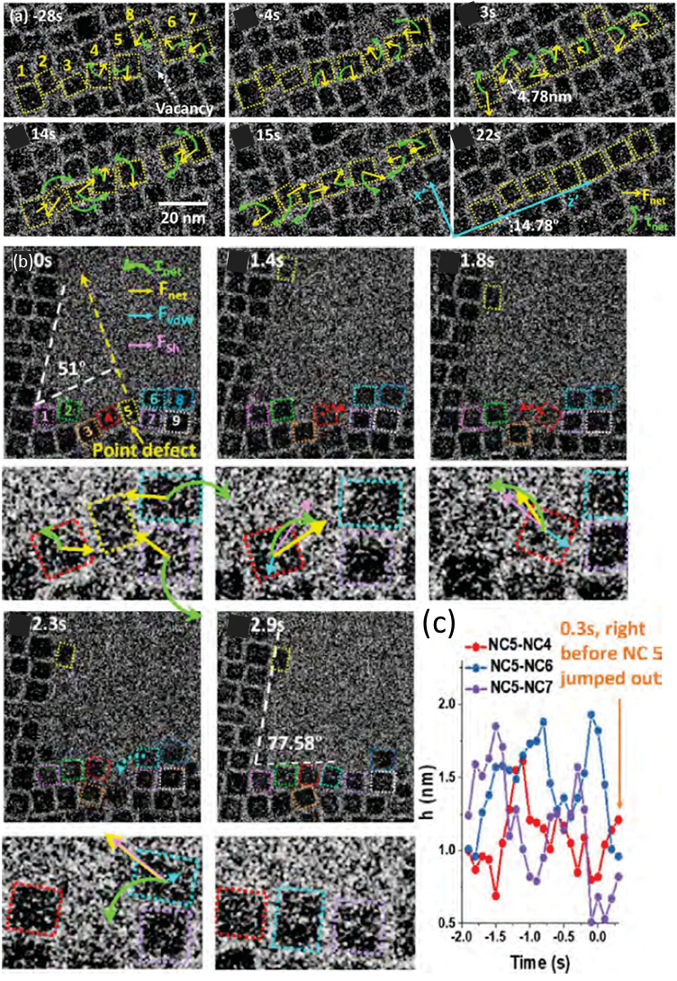 a) TEM footage frames showing self-elimination of a vacancy during self assembly of palladium nanocubes. The length of the arrows indicates the logarithm scale of the net magnitudes of Fnet and τ. b) TEM frames showing self-elimination of a point defect during self assembly of palladium nanocubes. Corresponding lower frames show translational and rotational movements represented by arrows. The arrow lengths represent the logarithmic scale of the calculated magnitudes for Fnet, FvdW, FSh, and τNet. c) Measured separations between NC pairs (5–4, 5–6, and 5–7) prior to the ejection of NC 5. Dashed arrows indicate the nanocube movement directions, with sizes scaled according to logarithmic magnitude. Copyright © 2024 The Authors. Published by American Chemical Society
In-situ liquid phase TEM imaging revealed that structural defects including vacancies, point defects, and edge dislocations that form during self assembly of superlattices are not static. They are eliminated through successive translational and rotational motions of nanocubes, driven by unbalanced forces at defect sites. By correlating TEM observations with theoretical force calculations and molecular dynamics simulations, the study shows that ligand-induced steric hindrances are dominant over van der Waals and Brownian forces. As the nanoparticles move to fill in defects, they transmit these forces to neighboring particles, resulting in a larger network of movements that self-eliminate defects across the 2D lattice structure. This direct visualization offers a mechanistic explanation for defect healing in nanoparticle superlattices, paving the way for the development of strategies to design defect-free nanoparticle superlattices for advanced electronic and optoelectronic devices.
Reference: Jaewon Lee, Zexi Lu, Zhigang Wu, Colin Ophus, Gregory K. Schenter, James J. De Yoreo, Jaehun Chun, and Dongsheng Li, ACS Nano, 18(47), 32386–32400 (2024) DOI: 10.1021/acsnano.3c08610
Full paper Copyright © 2024 The Authors. Published by American Chemical Society
View All News