
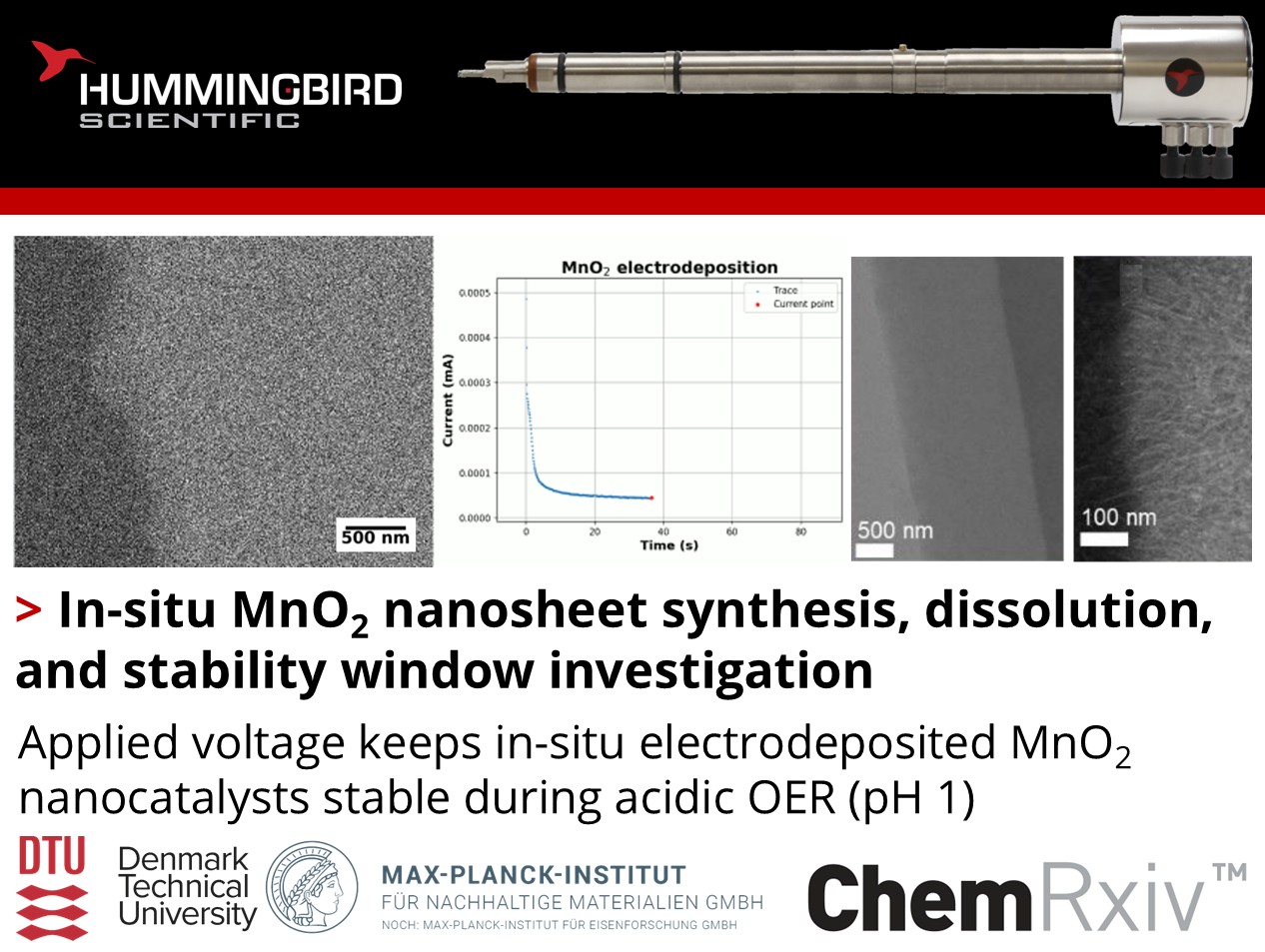
How can narrow electrocatalyst stability windows be identified in a nanoscale cell?
Lau Morten Kaas, Alexander Juul Nielsen, Feng Wu, Alba Bech Larsen, Marika Birkedal Norby, Christian Danvad Damsgaard, Stig Helveg, Jakob Kibsgaard, and Peter Christian Kjærgaard Vesborgand from the Technical University of Denmark and the Center for Visualizing Catalytic Processes (VISION) along with their colleagues at the Max-Planck-Institute for Sustainable Materials used the Hummingbird Scientific Gen V Liquid Electrochemistry TEM sample holder to synthesize ε-MnO2 nanosheets and investigate a potential stable regime for the oxygen evolution reaction (OER) at a pH of 1. Operando electrochemical scanning flow cell-inductively coupled plasma mass spectrometry (SFC-ICPMS) and identical location scanning TEM (ILSTEM) were combined with electrochemical-liquid phase TEM (ec-LPTEM) to correlate nanosheet microstructural evolution and operando current response.

a) Operando electrodeposition of MnO2 thin film onto WE. b) Corresponding current response over time during electrodeposition. c) Evolution of the growth and dissolution of MnO2 upon lowering the pH for WE1 and WE9. (c, d) Pristine WE1 and WE9. (e, f) Grown MnO2 layer without beam illumination by CA at 1.3 V Ag/AgCl 3M KCl for a total of 170 s. g) WE1 after the introduction of 100 mM HClO4 electrolyte with continuous beam illumination. h) WE9 after the introduction of 100 mM HClO4 electrolyte in absence of beam illumination. The figure shows that pH 1 electrolyte induces the dissolution of the MnO2 layer dissolves regardless of the electron beam illumination. Copyright © 2025 This work is licensed under a Creative Commons Attribution-NonCommercial-NoDerivatives0 International License.
MnO2 nanosheets were synthesized in-situ using an on-chip Pt/C working electrode (WE), on-chip Pt counter electrode (CE) and the Ag/AgCl 2M KCl Generation V bulk reference electrode (RE). After deposition, chronoamperometry induced nanosheet dissolution, with dissolution kinetics slowing for higher applied voltages. Other synthesized nanosheets were then acidified with pH 1 ClO4, chemically inducing dissolution. The Hummingbird-fabricated chips allowed a downstream WE to be characterized with the electron beam on and an upstream WE to be characterized before and after with no beam effects. A narrow window of stability where no dissolution occurs was isolated between 1.5-1.55 VRHE and corroborated by ex-situ and spectrometric techniques. The combination of versatile on-chip WE geometries and a robust bulk-scale RE included with the @Hummingbird Scientific Liquid Electrochemistry sample holder facilitated mechanistic determination of electrocatalyst stability windows, connecting stability to a combined effect of MnO2 reduction to Mn2+ at potentials below 1.5 VRHE and oxidation to MnO4– above 1.55 VRHE.
Reference: Raquel Aymerich Armengol, Lau Morten Kaas, Alexander Juul Nielsen, Feng Wu, Alba Bech Larsen, Marika Birkedal Norby, Andrea M. Mingers, Siyuan Zhang, Christian Danvad Damsgaard, Stig Helveg, Jakob Kibsgaard, and Peter Christian Kjærgaard Vesborg, ChemRxiv, w9lhv (2025) DOI: 10.26434/chemrxiv-2025-w9lhv
Full paper Copyright © 2025 This work is licensed under a Creative Commons Attribution-NonCommercial-NoDerivatives 4.0 International License.
View All News