

What does in-situ LPTEM reveal about gallium nanoparticle stability beyond the thermodynamic reduction potential of their oxide exterior?
Krishna Kumar, Raffaella Buonsanti, and their colleagues at EPFL demonstrated the utility of the Hummingbird Scientific bulk liquid-electrochemical TEM sample holder to characterize liquid metal (LM) Ga electrocatalyst nanoparticles under CO2 reduction reaction (CO2RR). Operando high angle annular dark-field scanning transmission electron microscopy (HAADF-STEM) was combined with energy dispersive X-ray spectroscopy (EDS) and liner sweep voltammetry (LSV) to characterize morphological transformations of the nanoparticles at various applied voltages.
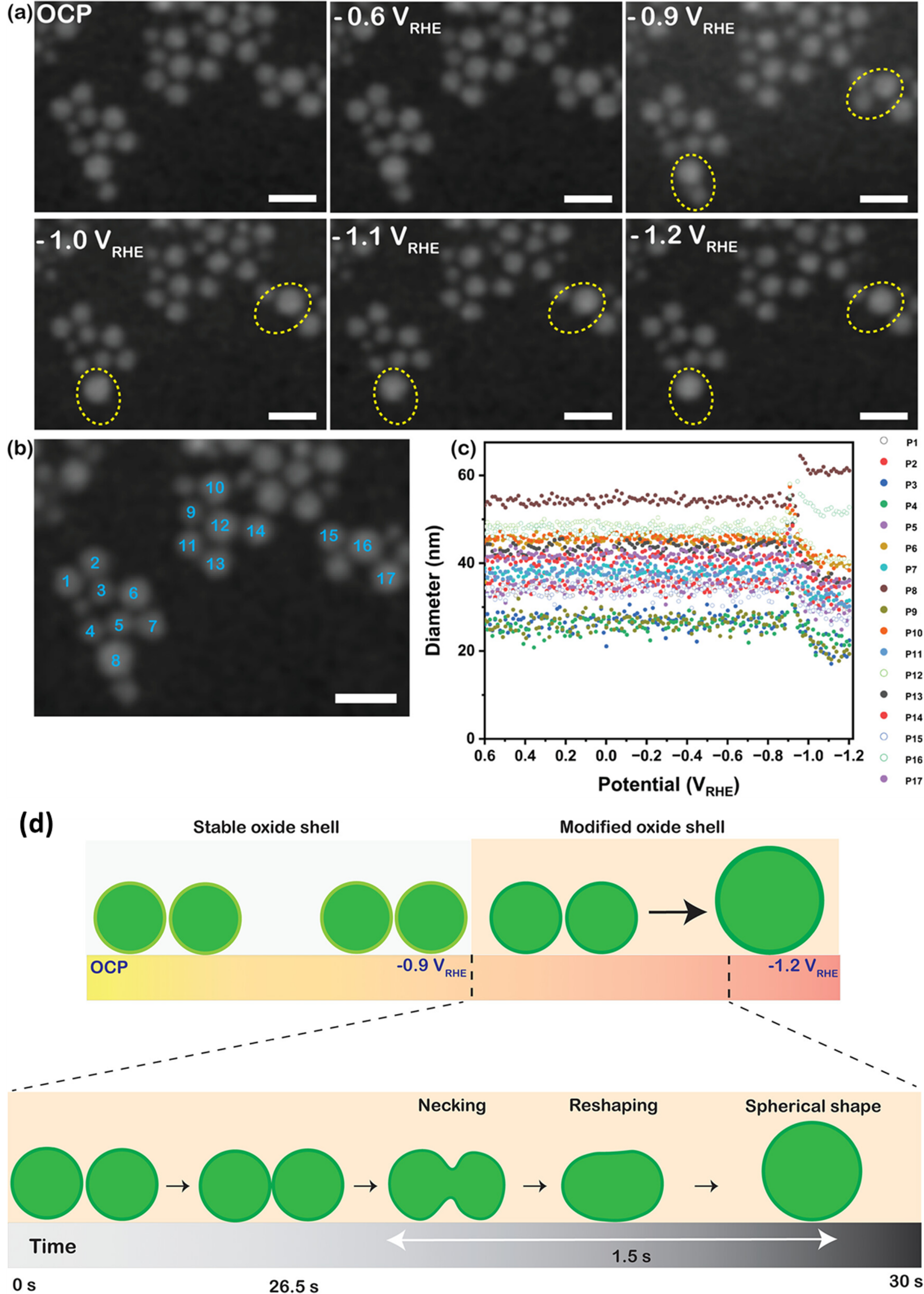
Evolution of the Ga nanoparticles at different cathodic potentials during LSV monitored by ecLPTEM. a) HAADF-STEM snapshot images of sweeping from OCP (0.6 VRHE) to –1.2 VRHE. The potential varies at 20 mV/s with no stabilization time in between. Size changes and coalescence of some NPs (yellow dot circles) are observed at potentials more cathodic than –0.9 V. b) Indexing map and c) monitored NPs size evolution at different potentials during LSV. d) Schematic representation illustrating the correlation between applied potential, oxide shell dynamics, and the mechanistic framework for stability under CO2RR conditions. Copyright © 2025 The Authors. Published by American Chemical Society. This publication is licensed under CC-BY 4.0.
The nanoparticles remained stable at applied voltages down to -0.9 VRHE (reversible hydrogen electrode) due to kinetic limitations, lower than the thermodynamically-expected reduction potential of the GaOx particle shell (~-0.56 VRHE). Below -1.2 VRHE, capillary-driven contact and necking between particles leading to agglomeration and growth into larger LM droplets became pronounced. The real Ag/AgCl bulk reference electrode in the Hummingbird Scientific Gen V TEM liquid-electrochemical sample holder enabled robust determination of potential windows from LSV measurements to be directly linked to stable and dynamic evolution regimes and extrapolated to macroscale CO2RR for future electrocatalysis design.
Reference: Krishna Kumar, Anna Loiudice, Coline Boulanger, Seyedmohamadjavad Chabok & Raffaella Buonsanti, Chem. Mater. 37, (19) 7952–7961 (2025) DOI: 10.1021/acs.chemmater.5c01734
Full paper Copyright © 2025 The Authors. Published by American Chemical Society. This publication is licensed under CC-BY 4.0.
View All News