
What role does dense liquid phase formation play in biomineralization?
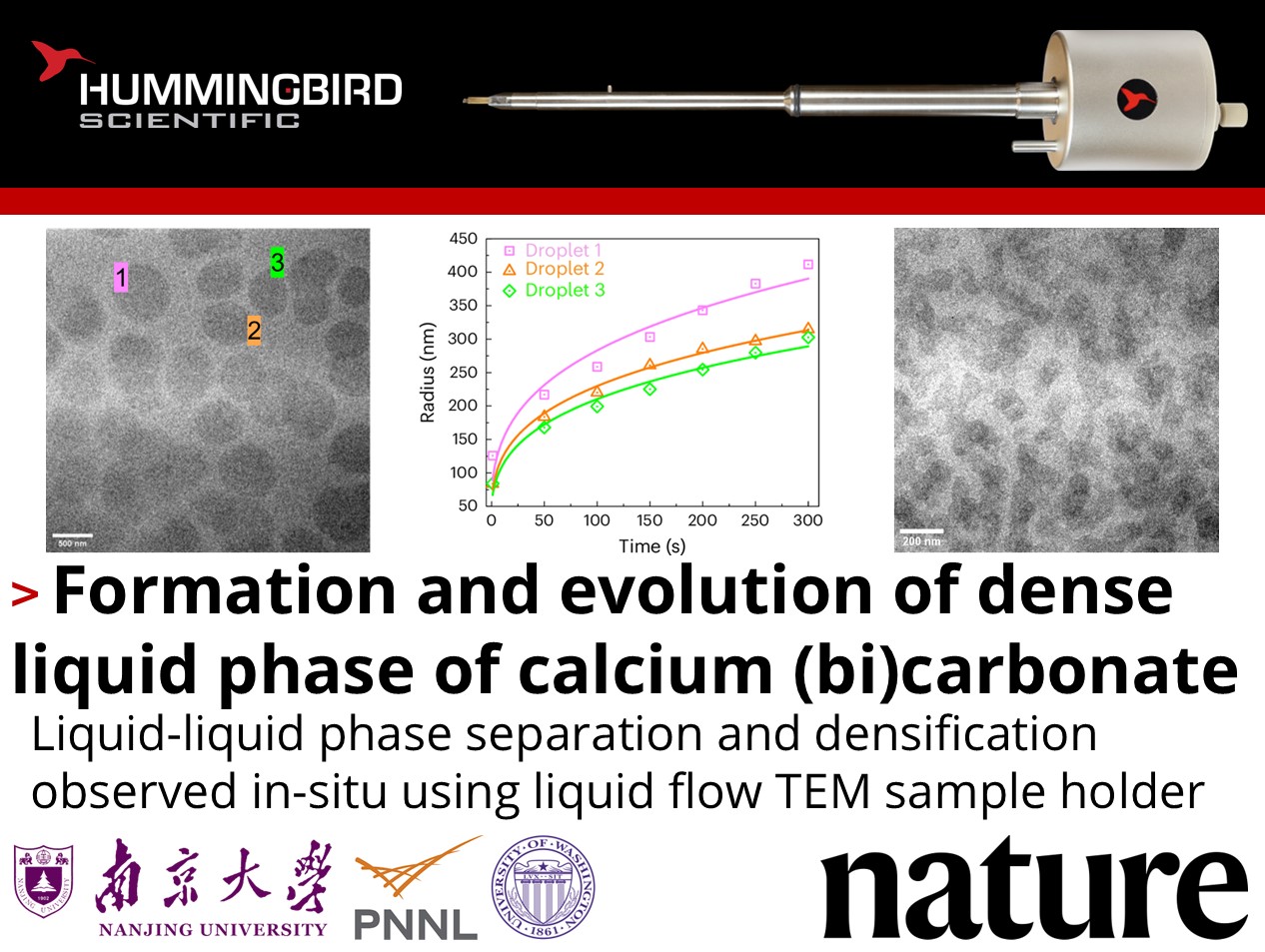
Biao Jin, Ying Chen, James De Yoreo, and their colleagues at Pacific Northwest National Laboratory, and the University of Washington – Seattle published recent work using their Hummingbird Scientific Gen IV in-situ liquid flow TEM sample holder to investigate the formation and solidification of a highly hydrated bicarbonate dense liquid phase (DLP) via liquid-liquid phase separation and subsequent transformation into hollow hydrated amorphous CaCO3 particles.
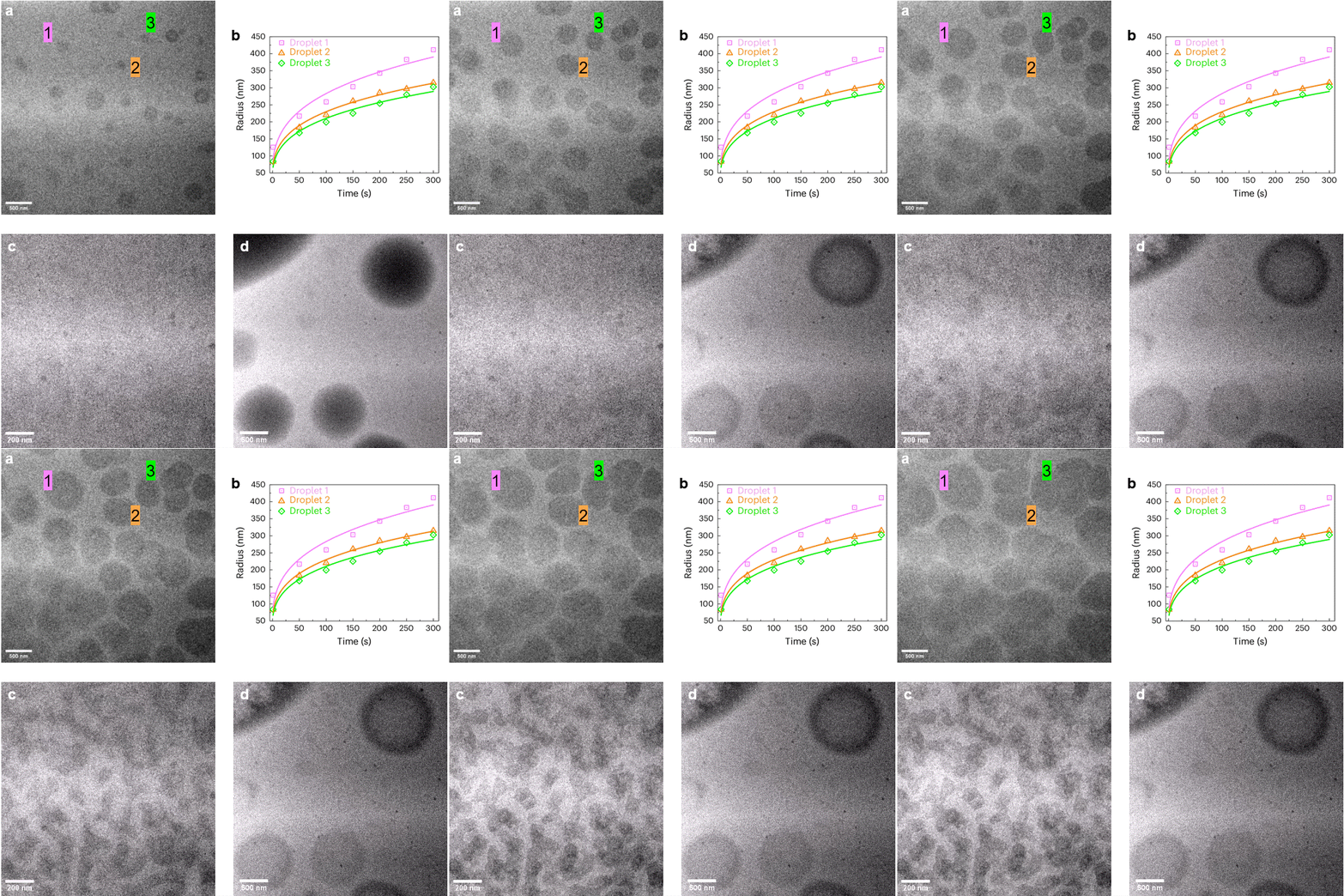
a) Video showing the formation and growth of DLP droplets in liquid cell. b) Measured radius of three droplets labeled in (a). c) Video showing formation of branched and worm-like DLP network. d) Video showing evolution of DLP droplets into hollow hydrated amorphous CaCO3 particles. Copyright © Battelle Memorial Institute and the Authors, under exclusive license to Springer Nature Limited 2024
Changes to morphology and growth rate were tracked using time-resolved transmission electron microscopy under various chemical conditions. The evolution of various ionic species were tracked using nuclear magnetic resonance (NMR), confirming the chemical mechanisms governing DLP formation and decomposition. Acidic proteins and polymers were found to extend the DLP lifetimes. Branched, worm-like DLP forms in the presence of CaCl2 and NaHCO3. The Hummingbird Scientific Gen IV in-situ liquid flow TEM sample holder enabled direct visualization of liquid–liquid phase separation into dense liquid phases and its influence on carbonate mineralization, providing insights that will guide the future optimization of biomineralization processes.
Reference: Biao Jin, Ying Chen, Harley Pyles, Marcel D. Baer, Benjamin A. Legg, Zheming Wang, Nancy M. Washton, Karl T. Mueller, David Baker, Gregory K. Schenter, Christopher J. Mundy, James J. De Yoreo, Nature Materials (2024) DOI: 10.1038/s41563-024-02025-5
Full paper Copyright © Battelle Memorial Institute and the Authors, under exclusive license to Springer Nature Limited 2024
View All News