
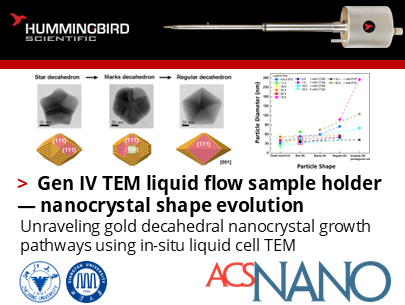
How can nanocrystal growth pathways be studied using Liquid-phase TEM?
Xiaoming Ma, Huimin Yin, Ruikang Tang, and Chuanhong Jin from Zhejiang University and Xiangtan University have used the Hummingbird Scientific Gen IV liquid flow TEM sample holder for in-situ observation of the nucleation, growth, and shape evolution of gold decahedral nanocrystals in solution. Their work provides unprecedented insight into dynamic growth pathways and size-dependent structural transitions that govern metal nanocrystal morphology.
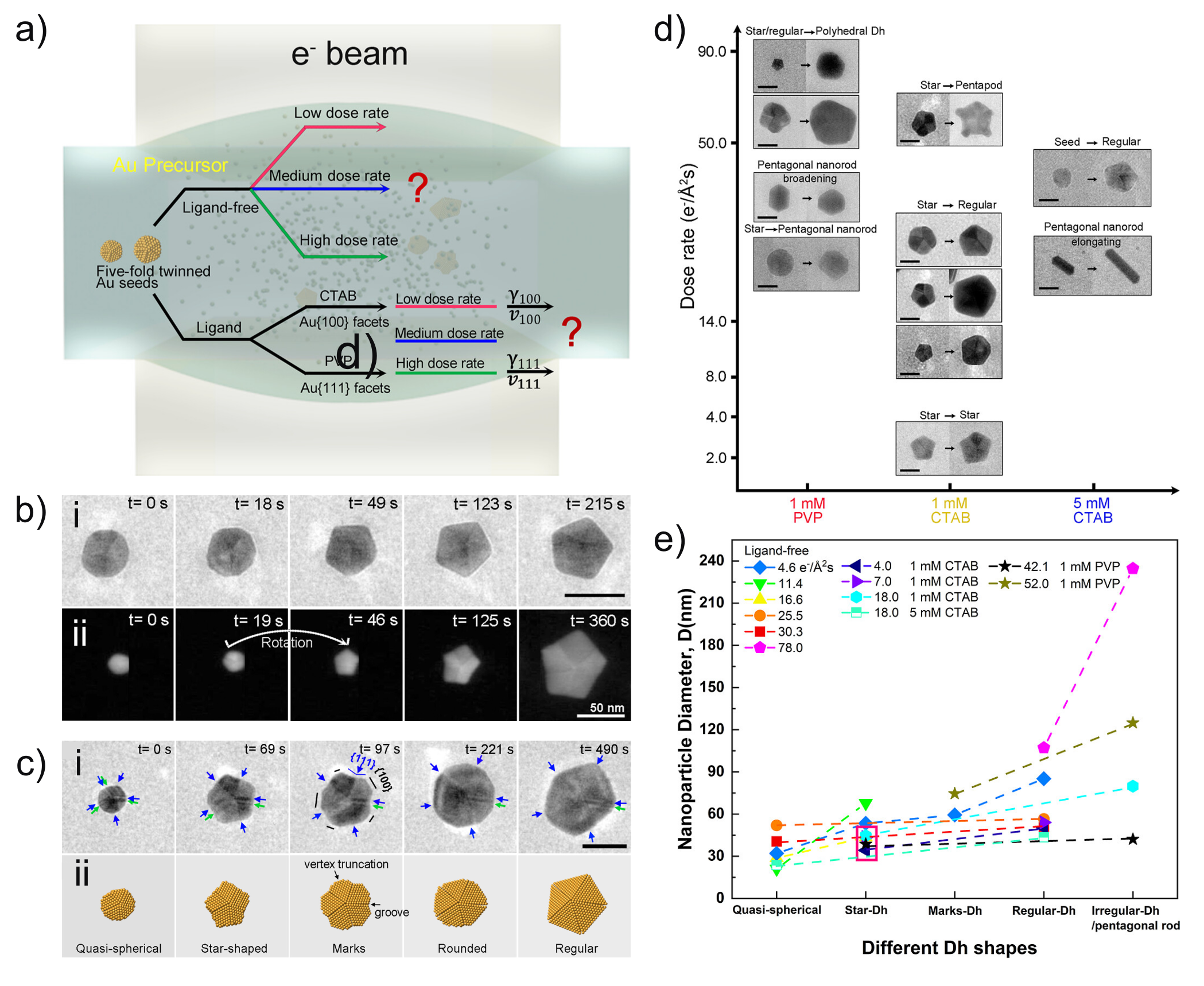 a) Schematic of the LCTEM setup used to track structural transformation pathways of gold decahedral nanocrystals under varying electron dose rates and ligand environments. b) In situ transformation of quasi-spherical five-twin seeds into regular and star decahedra in ligand-free 5 mM HAuCl₄. (i) Time-sequential TEM images capturing regular decahedron growth at an electron dose rate of 30.3 e⁻/Ų·s, and (ii) the associated growth diagram. Scale bar: 50 nm. c) In situ transformation of a decahedral Au multiply twinned nanoparticle from quasi-spherical to star-shaped and then to a regular decahedron. (i) Time-series TEM images and (ii) matching structural models. Blue and green arrows in (i) denote twin boundaries and thin parallel layers. Scale bar: 50 nm. Electron dose rate: 4.58 e⁻/Ų·s. d) Influence of electron dose rate and surfactant chemistry on the transformation pathways and final shapes of Au decahedra in in situ LC-TEM. Scale bars: 50 nm. e) Critical sizes of different decahedral morphologies observed during growth and transformation as a function of electron dose rate and surfactant type/concentration. Copyright © 2025 American Chemical Society
Using the Hummingbird Scientific liquid cell platform, the researchers created a sealed, nanometer-thin HAuCl₄ layer between SiNₓ membranes, enabling stable, high-resolution, real-time imaging in the TEM. By adjusting electron dose and adding surfactants such as PVP and CTAB, they controlled the local reaction environment and directly observed processes typically hidden during colloidal synthesis—including twin-boundary nucleation, rotation of 5-fold seeds, vertex truncation, facet-selective growth, strain-relief events, and transitions between decahedral, Marks, star-shaped, and other morphologies. They found that the competition between growth at twin boundaries (vt) and vertices (vv) governs the final particle shape, and they captured size-dependent structural transitions that confirm strain-driven, kinetic pathways predicted by theory.
These insights were made possible by Hummingbird Scientific Gen IV liquid flow TEM sample holder with thin liquid spacing, precise control, and imaging stability allowing for continuous tracking of transient intermediates that traditional methods cannot resolve. By revealing how nanocrystals nucleate and transform in solution, this work strengthens our understanding of shape-evolution mechanisms and supports more rational nanoparticle design for catalysis, plasmonics, energy applications, and other fields that demand precise nanoscale control.
Reference: Xiaoming Ma, Huimin Yin, Ruikang Tang, and Chuanhong Jin, ACS Nano 19(43), 3817-38183 (2025). DOI: 10.1021/acsnano.5c15982
Full paper Copyright © 2025 American Chemical Society
View All News