
How does radiation influence boehmite dissolution pathways in aqueous environments?
Lili Liu, Jaehun Chun, Xin Zhang, Michel Sassi, Andrew G. Stack, Carolyn I. Pearce, Sue B. Clark, Kevin M. Rosso, James J. De Yoreo, and Greg A. Kimmel from Pacific Northwest National Laboratory and collaborating institutions used the Hummingbird Scientific liquid-cell TEM holder to investigate radiation-driven dissolution of boehmite (AlOOH) nanoplatelets under controlled electron flux. Their work provides new insight into how electron-beam-induced radiolysis accelerates platelet dissolution and alters aggregation dynamics, revealing mechanisms critical for nuclear waste processing and environmental remediation.

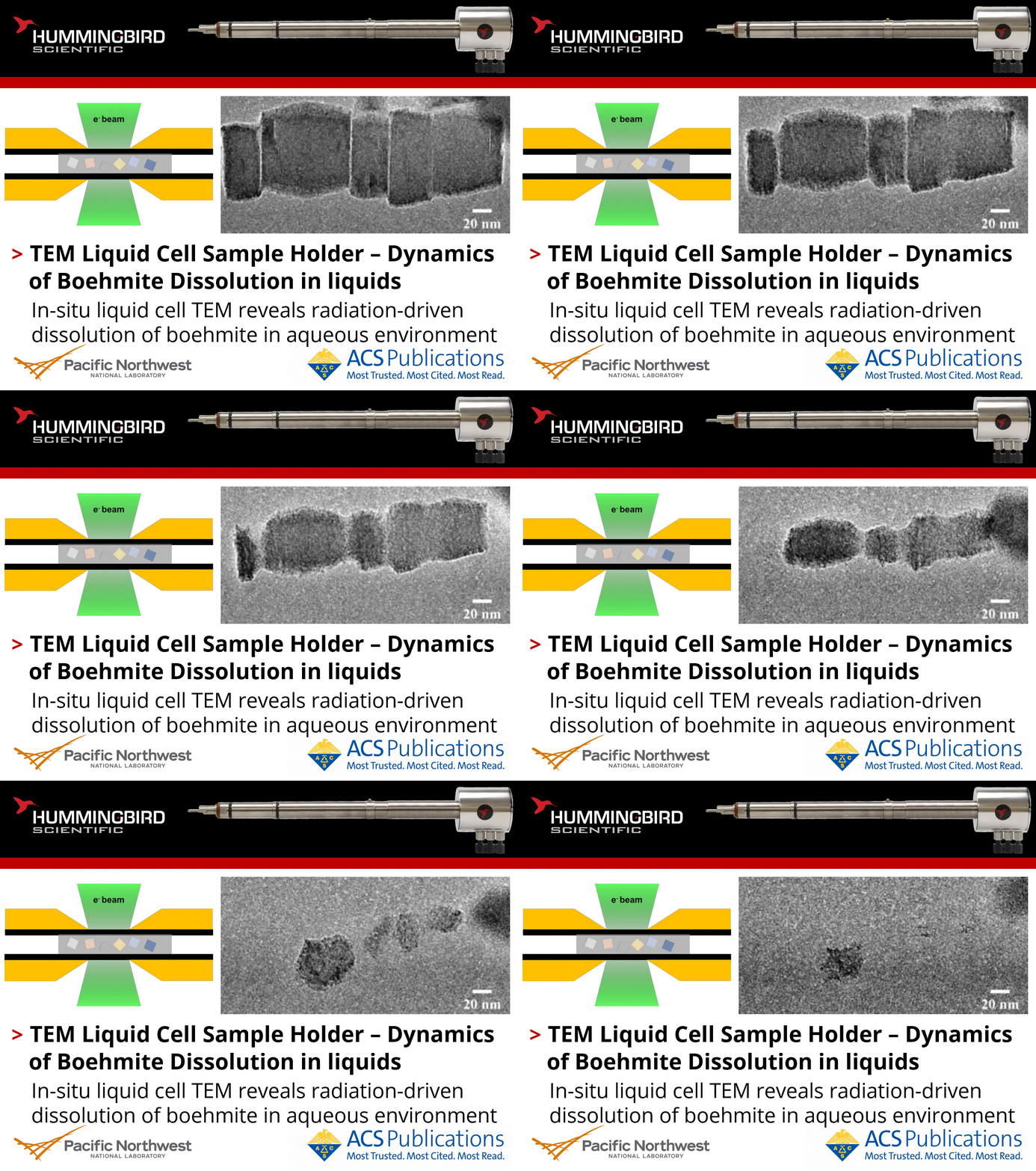
Left: Schematic diagram for the liquid cell and the assembly procedures. Right: Time evolution of boehmite aggregate nanostructure during the dissolution process at 6.0 e/(Å2s) electron dose rate. Copyright © 2022 American Chemical Society.
Electron-beam-induced ionization disrupts interlayer hydrogen bonding, creating surface charges that lead to repulsive forces and structural breakup.
The dose-rate dependence suggests that while TEM beam exposure accelerates degradation processes, actual waste tank conditions are far below the
threshold value to induce significant dissolution and delamination of tank waste at the DOE’s Hanford site in Washington State.
These findings inform predictive models for long-term stability of aluminum oxyhydroxides in radioactive environments. This work advances understanding of radiation–structure–reactivity coupling at the nanoscale, supporting strategies for selective boehmite removal and improved waste treatment processes.
Reference: Lili Liu et al., Environmental Science & Technology, 56, 5029–5036 (2022). DOI:10.1021/acs.est.1c08415
Full paper Copyright © 2022 American Chemical Society.
View All News