
How does solvent chemistry control nanoparticle interactions at the nanoscale?
Lili Liu, James J. De Yoreo, Jaehun Chun, Elias Nakouzi, and their colleagues from Pacific Northwest National Laboratory used the Hummingbird Scientific in situ TEM liquid flow sample holder to directly visualize solvent-driven oriented attachment of ZnO nanoparticles in a liquid environment.
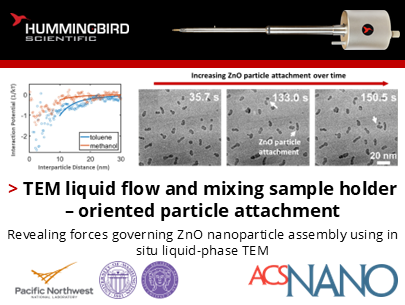
Using in situ liquid-phase TEM, the team captured time-resolved image sequences of individual ZnO nanoparticles suspended in toluene, allowing them to follow particle motion, rotation, alignment, and attachment events as they occurred. By tracking particle trajectories frame by frame, the researchers quantified separation-dependent behavior and extracted interaction potentials directly from experimental data, enabling direct comparison with earlier measurements performed in different solvent systems.

Figure: Solvent-dependent ZnO nanoparticle attachment observed by in situ liquid-phase TEM. (a, b) Time-resolved TEM image sequences capturing individual ZnO nanoparticles approaching and attaching in toluene. (c) Radial distribution analysis derived from particle trajectories, quantifying separation-dependent behavior in liquid. (d) Interaction potentials extracted from in situ measurements, compared with prior data collected in methanol, showing stronger long-range attractions in toluene consistent with dipole–dipole interactions.
To interpret these observations, the in situ TEM results were combined with Langevin dynamics simulations, classical DLVO calculations, zeta potential measurements, and atomic force microscopy force spectroscopy. This multi-technique approach revealed that solvent-dependent, long-range dipole–dipole interactions drive nanoparticle alignment and attraction, while short-range solvation forces influence attachment at near-contact separations—highlighting interaction mechanisms that extend beyond classical DLVO theory.
Together, these experiments show how stable, well-controlled liquid environments inside the TEM make it possible to quantitatively link solvent chemistry to nanoscale interaction forces. The Hummingbird Scientific in situ TEM liquid flow sample holder provided the experimental control and imaging stability needed to move from qualitative observation to predictive insight into nanoparticle assembly, crystal growth, and solvent-mediated materials behavior.
Reference: Lili Liu, Sakshi Yadav Schmid, Zhaojie Feng, Dongsheng Li, Timothy C. Droubay, Peter J. Pauzauskie, Gregory K. Schenter, James J. De Yoreo, Jaehun Chun, & Elias Nakouzi, Effect of Solvent Composition on Non-DLVO Forces and Oriented Attachment of Zinc Oxide Nanoparticles. ACS Nano 2024, 18, 26, 16743-16751. DOI: 10.1021/acsnano.4c01797
Full paper Copyright © 2024 American Chemical Society
View All News