
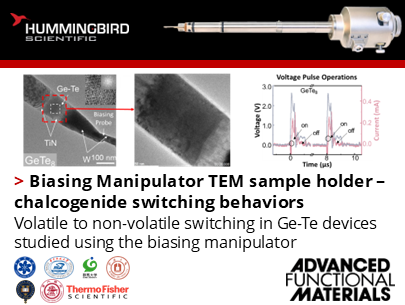
How does the Biasing Manipulator reveal nanoscale events during volatile-to-non-volatile transitions in Ge–Te devices?
Zihao Zhao, Mengfei Zhang, Zhitang Song and their colleagues from the Chinese Academy of Sciences, Min Zhu of Shanghai Jiao Tong University and their colleagues from Huazhong University of Science and Technology, Gunma University, Thermo Fisher Scientific China, Ningbo University, and University of Cambridge used the Hummingbird Scientific Biasing Manipulator TEM sample holder for direct in situ observation of the nanoscale structural rearrangements, phase transitions, and electrically driven switching pathways that govern volatile-to-non-volatile behavior in Ge–Te devices.

A) Evolution of threshold-switching (TS) phenomena in chalcogenides, including the ovonic threshold switch (OTS), ovonic memory switch (OMS), and phase-change switch (PCS). B) Cross-sectional TEM image of a Ge–Te device with a ~200 nm TiN plug, accompanied by stacked EDS elemental maps. C) I–V characteristics of Ge–Te compositions; GeTe exhibits non-volatile electrical behavior, while the other compositions show volatile switching. Arrows indicate the first and second pulse operations. D) Electrical performance of 200 nm bottom-electrode (BE) GeTe₂, GeTe₄, and GeTe₆ devices annealed at 400 °C for 30 min. E) Volatile I–V behavior of 200 nm BE GeTe₈ and GeTe₁₆ devices after the same annealing treatment. F) TEM image of the GeTe₈ nanodevice contacted by a W tip. The device consists of Cu, TiN, Ge–Te alloy, TiN, and W layers in a T-shaped architecture. G,H) Snapshots of the GeTe₈ device before and after the voltage-pulse operation shown in I. The as-deposited GeTe₈ film is initially polycrystalline, as indicated by the elliptical dashed regions and confirmed by the inset. Following volatile switching, the layer remains crystalline, but the grain orientations change. J–L) Snapshots of GeTe₄ nanodevices before, during, and after the voltage-pulse operation shown in M. The GeTe₄ layer remains amorphous throughout, even after two consecutive ON and OFF switching cycles. N-P) Snapshots of GeTe nanodevices before, during, and after the voltage-pulse operation shown in Q. Electrically, the device shows a clear switch-ON response but no corresponding OFF transition. A second pulse yields a linear, ohmic I–V response characteristic of OMS behavior.
In this study, the research team set out to understand how different Ge–Te materials switch between states when an electrical pulse is applied. They examined six compositions across the Ge–Te system and looked closely at how each material’s structure, stability, and crystallization behavior affected the way it turned “on” and “off.” By combining electrical tests with structural and thermal measurements, the team was able to build a clear picture of how these materials move from phase-change switching, to threshold switching, and finally to non-volatile memory behavior as their composition changes.
A key discovery was that Te-rich materials, such as GeTe₈ and GeTe₆, switch by briefly melting and recrystallizing, while mid-range compositions switch electronically without any structural change. At the Ge-rich end, GeTe transforms rapidly from amorphous to crystalline, allowing it to store information even after the electrical pulse is removed. This detailed map of switching behaviors helps explain long-standing questions about why some Ge–Te materials behave reliably during device operation while others fail after heating or prolonged use. The work also identifies crystalline GeTe₁₆ as a surprisingly strong candidate for future memory devices thanks to its low leakage current, high endurance, and ability to withstand high-temperature processing used in semiconductor manufacturing.
The Hummingbird Scientific Biasing Manipulator TEM sample holder enabled direct, real-time visualization of nanoscale structural changes under electrical excitation, clearly revealing the distinct switching mechanisms associated with each Ge–Te composition. These findings establish crystalline GeTe₁₆ as a high-performance, high-temperature-compatible selector material and point toward new strategies for developing more reliable and scalable memory architectures.
Reference: Zihao Zhao, Mengfei Zhang, Zhitang Song, Min Zhu, et. al. Adv. Funct. Mater. 35 (23), 2423940 (2025). DOI: 10.1002/adfm.202423940
Full paper Copyright © 2025 Wiley-VCH GmbH
View All News