
How can chromium-based TMF cathodes improve energy density and cycling stability in solid-state batteries?
Joel Casella, Marta D. Rossell, Yaroslav E. Romanyuk and their colleagues from Empa – Swiss Federal Laboratories for Materials Science and Technology, University of Oxford, and ETH Zurich transferred air-sensitive, lithiated Cr-LiF thin film cathodes to the TEM for testing cycling stability using the Hummingbird MEMS Air-free Transfer Biasing sample holder. The team used coevaporation of metallic Cr and LiF to fabricate heterogenous two-phase thin films with a tunable stoichiometric ratio.
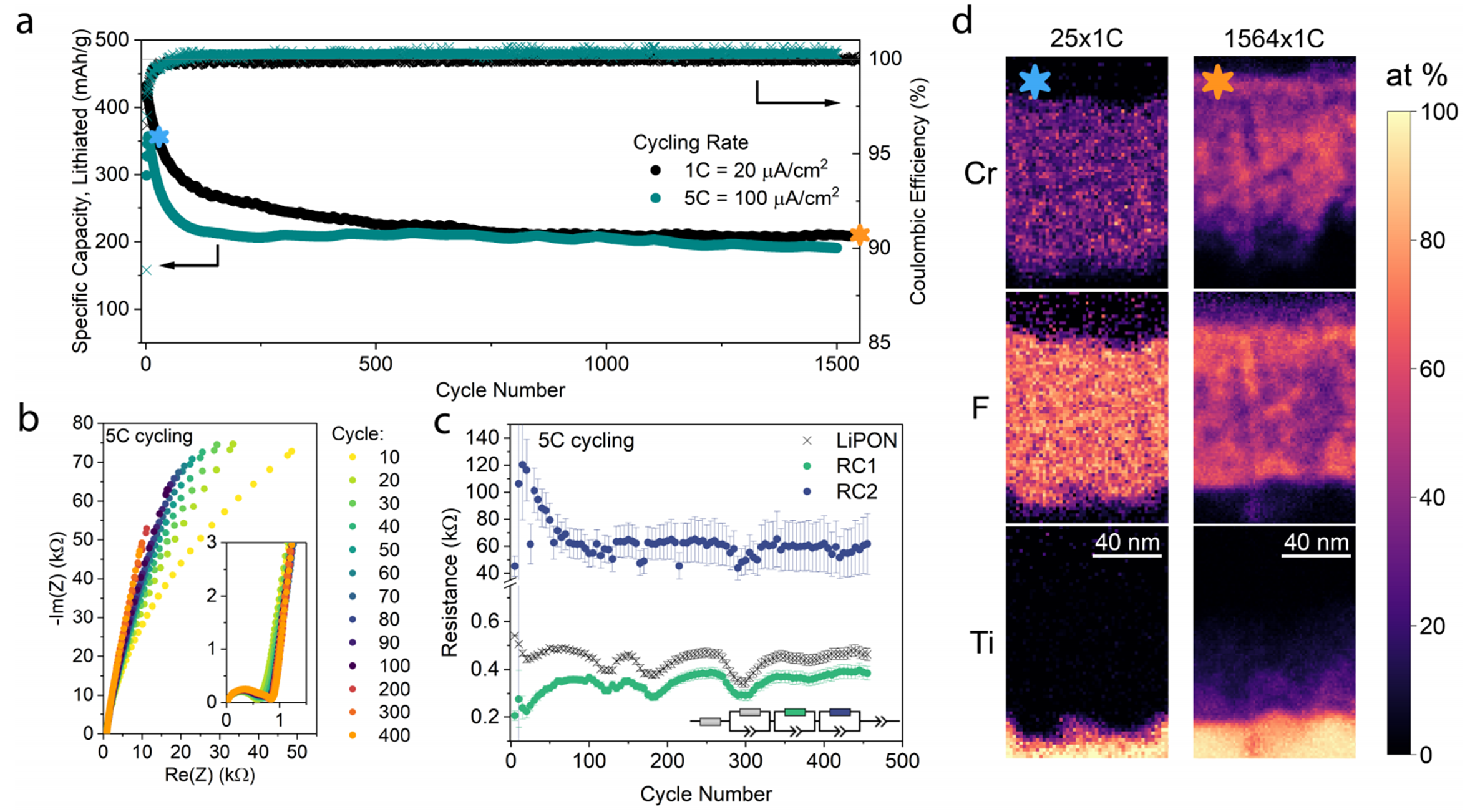
Long term behavior (a) Specific discharge capacity vs cycle number for a Cr-LiF cathode cycled at 1C (black) and 5C (teal). Coulombic efficiency is shown for all cycles on the right axis. (b) Nyquist representation of PEIS spectra taken after different cycle numbers. (c) Resistance vs cycle number for fitted resistance values of the LiPON, RC1,and RC2 contributions. The equivalent circuit used to fit the PEIS spectra is shown. (d) STEM-EDX maps of Cr, F, and Ti for samples after 25 cycles and 1564 cycles at 1C (shown as stars on panel (a)).
Copyright © 2025 ChemRxiv
This study introduces chromium-based transition metal fluoride (TMF) cathodes as a promising option for high-energy lithium-ion solid-state batteries. A Cr–LiF cathode (1.1:2) showed strong thin-film performance, delivering 435 mAh/g and 0.707 Wh/g at C/10, with better high-rate behavior than Fe–LiF cathodes. Modeling and experiments show conversion to CrF₂ during delithiation. Extended cycling forms a new nanostructure that improves kinetics with some capacity loss, resulting in stable operation over hundreds of cycles. This first demonstration of chromium-based TMF cathodes highlights their potential for future high-energy solid-state batteries.
Reference: Joel Casella, J¸edrzej Morzy, Vittorio Montanelli, Felix C. Mocanu, Arnold Muller, Moritz H. Futscher, Marta D. Rossell, M. Saiful Islam, Maksym Yarema, and Yaroslav E. Romanyuk. ChemRxiv (2025) DOI: 10.26434/chemrxiv-2025-thlxs
Full paper Copyright © 2025 ChemRxiv – Authors. All rights reserved.
View All News